
How to Start Amazon FBA: Build Your Amazon E-Commerce Company
Starting an Amazon FBA (Fulfillment by Amazon) business is one of the fastest ways to launch a real Amazon e-commerce company by leveraging the world largest retail logistics network to store, pack, ship, and service orders. Rather than building website traffic from zero or paying steep ad costs on unproven private-label items, beginners often launch through retail or online arbitrage—reselling established brand-name products with existing search demand. Turning a side store into a durable Amazon e-commerce company requires mastering Seller Central setup, updated brand-ungating invoice thresholds, modern placement surcharges, and knowing when to keep operations in-house versus delegating.

Try our free ROI Calculator to calculate your Amazon FBA inventory return and net margin.
1. How the Amazon FBA reselling model works for beginners
Amazon FBA reselling works by sourcing discounted, established brand-name products from retail stores or authorized wholesalers, applying Amazon barcode labels, and shipping cartons to fulfillment centers where Amazon handles delivery, returns, and Prime shipping eligibility.
Beginners choose between two primary FBA paths: private label (designing and manufacturing a custom branded product from factories and buying pay-per-click ads to create demand) or arbitrage and wholesale (attaching your offer to existing brand-name listings that already earn thousands of searches every month). Reselling recognized brands eliminates marketing risk because buyers already trust the product name—success depends purely on sourcing below wholesale/clearance cost, securing brand approval, and protecting net profit after marketplace fees.
- Built-in customer demand: established listings convert organically without spending upfront capital on sponsored ad campaigns.
- Prime shipping trust: FBA inventory earns the Prime badge automatically, driving substantially higher conversion rates than seller-fulfilled listings.
- Hands-off customer service: Amazon warehouse teams pick, pack, deliver, and manage customer returns across every order.
- Repeatable cash cycling: profits from small test batches can be rolled immediately into faster-turning replenishment inventory.
2. Step 1: Registering on Seller Central and selecting the right selling plan
Every seller begins at Amazon Seller Central, choosing between the Individual selling plan ($0.99 per item sold, no monthly subscription) and the Professional selling plan ($39.99 per month flat subscription with zero per-item fee).
Why the Professional Plan Wins for Active FBA Sellers: Beyond breaking even mathematically at 41 units per month, the Professional tier is required to win the Featured Offer (Buy Box), unlock automated repricing integrations, access business analytics reports, and submit applications to ungate restricted brands and categories. Keep in mind that Amazon frequently charges the initial $39.99 Professional fee upon sign-up to verify your payment method, even if you later request a switch to Individual while setting up.
Account Verification Checklist: Prepare every document cleanly before starting registration because mismatched details trigger weeks of automated identity holds. You must be at least 18 years old and hold a valid government-issued photo ID (a passport or driver license with matching address), a dedicated business email separate from personal Amazon Prime shopping accounts, an active credit or valid debit card capable of international verification charges, a checking account and routing number for biweekly payouts, and your SSN or IRS Employer Identification Number (EIN). You do not need an LLC on day one; many sellers operate as sole proprietors until monthly gross sales reach $5,000 to $10,000 and then incorporate for liability shielding and wholesale distributor trade accounts.
- Professional plan threshold: break-even occurs at 41 units monthly ($39.99 vs. $0.99/item), plus essential Buy Box eligibility.
- Exact identity matching: ensure your bank statement, ID, and Seller Central profile match character-for-character to avoid verification delays.
- Dedicated seller email: separate business notifications and compliance alerts from personal consumer shopping accounts.
- Banking setup tip: if your regional bank does not appear in the instant dropdown list during payout setup, select the manual routing entry option.
3. Step 2: Gathering low-cost prep materials or choosing a sales-tax-free prep center
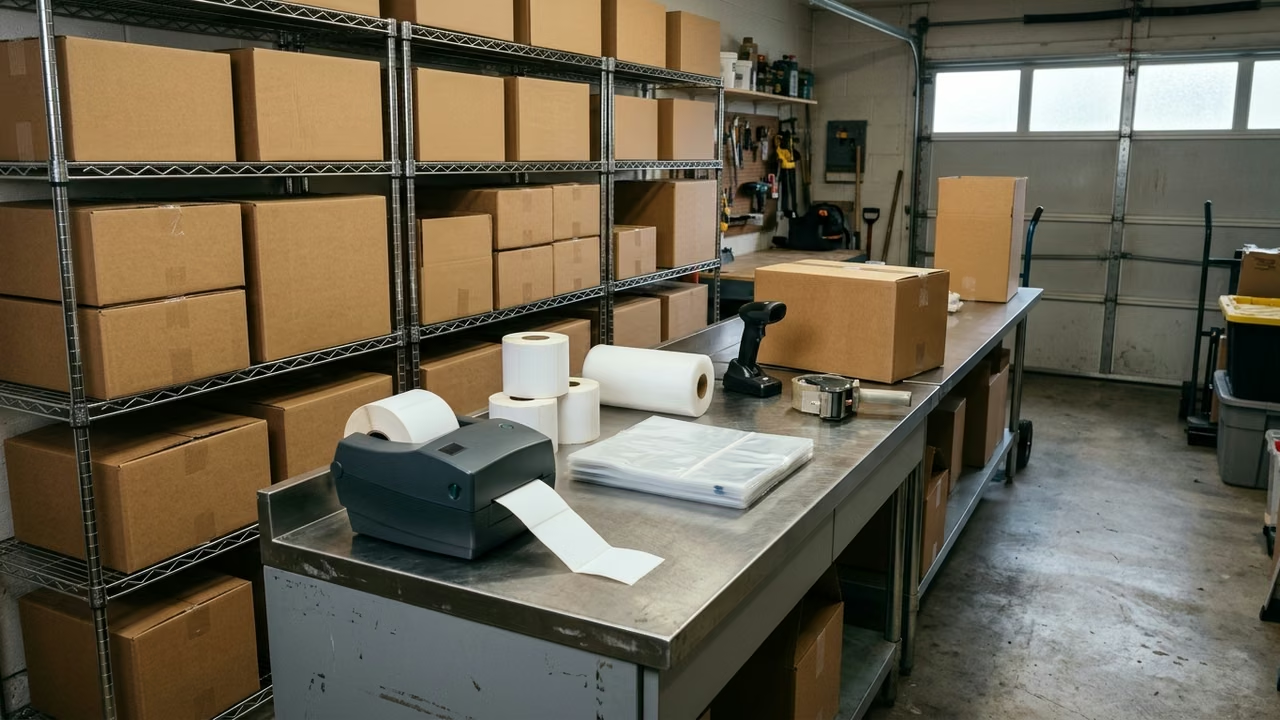
Before buying inventory, assemble the physical prep station needed to turn retail or wholesale goods into warehouse-compliant FBA units—or line up a third-party prep center if you lack storage space or live in a high-sales-tax state.
DIY Home Prep Starter Kit ($150 – $250): Beginners benefit enormously from handling their first 100 to 200 units themselves because hands-on prep exposes every labeling requirement and fee deduction firsthand. You need a direct thermal label printer capable of printing 4x6 shipping labels and 2x1 FNSKU product barcode labels (thermal printing uses zero ink cartridges), clear poly bags with pre-printed suffocation warnings for apparel, plush, or loose items, "Sold as Set — Do Not Separate" stickers for multi-pack bundles, heavy-duty packing tape, and a heat gun or adhesive remover to strip retail clearance tags cleanly. Corrugated shipping boxes can often be sourced free from local retail stockrooms or shipped via standard 18x14x12 moving boxes under Amazon 50-pound weight and 25-inch side limits.
When to Use a Tax-Free Prep Center: Once volume grows, online arbitrage sellers frequently outsource receiving, inspection, and labeling to prep centers located in sales-tax-free states (Delaware, Oregon, Montana, or New Hampshire). Shipping online orders directly to a prep center in a tax-free state eliminates 6% to 10% retail sales tax on your cost of goods—savings that often pay for the $0.75 to $1.50 per-unit prep fee while freeing hours of manual labor.
- Thermal printer efficiency: invest in one thermal printer handling both 2x1 FNSKU item labels and 4x6 outer carton labels.
- Clean retail sticker removal: always strip clearance price tags so buyers never see discounted retail prices upon delivery.
- Weight and box rules: keep standard FBA shipping cartons under 50 pounds and under 25 inches on any single side.
- Tax-free 3PL leverage: prep centers in Oregon, Delaware, Montana, or New Hampshire save 6%–10% sales tax on inventory purchases.
4. Step 3: Getting ungated in restricted brands and categories (updated invoice rules)
Amazon blocks new seller accounts from listing major consumer brands and sensitive categories (such as Grocery, Topical Beauty, Toys, and Electronics) until you pass a verification gate called ungating.
Updated Unit & Distributor Requirements: Historically, resellers unlocked major brands by buying 10 units from an online wholesaler. Under stricter modern enforcement, Amazon routinely demands commercial invoices showing 100 units (and occasionally up to 300 or 400 units for top-tier athletic or electronics brands) before unlocking restricted listings. Always test the exact gate before spending money: inside Seller Central, open Catalog, click Add Products, search the target ASIN, select Show limitations, and click Request Approval to see whether Amazon accepts 10 units or requires 100+ units.
Non-Negotiable Wholesale Invoice Standards: Never submit retail receipts from big-box stores, altered PDFs, or quotes—submitting edited documents risks immediate account suspension. Your distributor invoice must be dated within 90 to 180 days, show the wholesale supplier full business name, physical address, website, and phone number, display your exact Seller Central Legal Entity name and address in the "Bill To" block, list matching UPC/model numbers clearly, and include uncropped high-resolution photos of the physical product packaging and brand trademarks if requested. Expect automated rejections on early submissions; re-verifying clear highlights around your name, supplier details, and unit quantities often resolves automated denials on subsequent attempts.
- Check unit thresholds first: verify inside Seller Central whether a brand requires 10 units or 100+ units before ordering stock.
- Use legitimate B2B wholesalers: retail store receipts and consumer invoices fail automated brand-approval reviews.
- Verify exact legal entity match: bill-to name and suite address on distributor invoices must match Seller Central character-for-character.
- Unlock 10 to 15 starter brands early: building an initial catalog of unlocked everyday brands dramatically expands daily sourcing finds.
5. Step 4: Buying your sourcing and accounting software at the right time
Do not pay for monthly product research subscriptions while you are still waiting on Seller Central identity checks or gathering initial ungating invoices. Purchase software tools strictly after your account is verified and you are actively evaluating live inventory.
Essential Starter Tools for Sourcing & Operations:
1. SellerAmp SAS (~$19.95/month): Your primary deal-analysis Chrome extension and mobile scanner. SellerAmp instantly shows net profit, ROI, estimated monthly sales, Buy Box rotation across competing sellers, total competitor stock levels, IP complaint alerts, and whether your seller account is gated or approved to sell the ASIN.
2. Keepa (~€19/month): The non-negotiable price-history chart every reseller checks before buying. Keepa exposes 90-day and 365-day Buy Box stability, Best Seller Rank drops, and whether Amazon Retail frequently jumps back onto the listing at rock-bottom prices.
3. Sellerboard (~$19/month): Add an accurate profit dashboard only once your first shipment goes live. Unlike basic Seller Central revenue screens, Sellerboard reconciles referral fees, fulfillment charges, storage, refunds, lost-inventory reimbursements, and automated review requests.
4. Automated Repricing Tools like BQool (~$25–$50/month): Reprice manually inside Seller Central for your first 15 to 25 SKUs to keep overhead lean. Upgrade to a rule-based or algorithmic repricer only once managing 25+ active listings becomes too time-consuming manually.
- Sequence subscriptions smartly: subscribe to SellerAmp and Keepa only when ready to spend daily hours sourcing stock.
- Protect margins from IP complaints: verify SellerAmp intellectual-property alerts before buying unfamiliar third-party brands.
- Add profit accounting at launch: track lost warehouse units and refund rates once live shipments arrive at Amazon.
- Delay repricing software early: manual daily price adjustments save $300 to $600 per year during your first few months.
6. Updated Amazon FBA fees, placement charges, and profit margin math
Modern Amazon FBA sellers must factor five distinct fee layers into every sourcing decision rather than relying on outdated flat-fee estimates. Missing newly introduced inbound placement or low-inventory charges can turn a seemingly profitable 25% ROI product into a break-even loss.
Core FBA Fee Components: First, Amazon deducts a category Referral Fee (typically 8% to 15% of total selling price). Second, Amazon charges a weight- and size-tiered FBA Fulfillment Fee for picking, packing, and shipping. Third, under updated Inbound Placement Service Fees, shipping inventory to one regional location (Minimal Splits) incurs an extra per-unit redistribution charge ($0.21 to $0.68+ for standard-size items), whereas sending identical case packs to multiple Amazon-specified warehouses (Amazon-Optimized Splits) waives the placement fee. Fourth, standard-size products trigger a Low-Inventory-Level Fee whenever both 30-day and 90-day historical days of supply fall below 28 days. Finally, monthly storage fees spike significantly during peak fourth-quarter holiday months (October through December).
Worked Profit & ROI Example: Suppose you source a popular household kitchen accessory via online arbitrage for $14.00 (pre-tax via a tax-free prep center) and sell it on Amazon for $34.99. Deducting a 15% referral fee ($5.25), standard FBA fulfillment fee ($4.75), $1.00 inbound shipping and prep fee, and $0.30 inbound placement allowance yields total marketplace and prep costs of $11.30. Subtracting $14.00 product cost and $11.30 fees leaves $9.69 net profit per unit—a 27.7% net profit margin and 69.2% ROI on your $14.00 inventory spend. Validate your own SKUs before buying using our ROI Calculator, Profit Margin Calculator, and Break-Even Point Calculator.
Amazon FBA Net Profit and ROI Formula:
Total Fees = Referral Fee (8%–15%) + FBA Fulfillment Fee + Inbound Placement / Shipping + Prep Cost + Monthly Storage
Net Profit per Unit = Amazon Selling Price - Product Cost (COGS) - Total Fees
Return on Investment (ROI) = (Net Profit per Unit / Product Cost) x 100
Worked Example ($34.99 Sale Price; $14.00 COGS; $11.30 Total FBA & Prep Fees): $34.99 - $14.00 - $11.30 = $9.69 Net Profit (69.2% ROI; 27.7% Net Margin)
- Audit inbound placement splits: optimize case quantities when possible to capture $0 Amazon-Optimized placement rates.
- Maintain 4–8 weeks of stock: keep healthy inventory buffers on winning SKUs to avoid Low-Inventory-Level surcharges.
- Account for return buffers: set aside 2% to 4% of gross revenue in beauty, apparel, and electronics for unresellable returns.
- Target strict buy minimums: most experienced arbitrage sellers require at least $4 to $5 net profit and 30%+ ROI per unit.
7. Sourcing strategies compared: Retail Arbitrage, Online Arbitrage, and Wholesale
Selecting the right sourcing method shapes your daily schedule, capital efficiency, competition risk, and scalability. Comparing all three reselling channels helps beginners pick a realistic launch workflow.
| Sourcing Method | Typical Starting Capital | Competition & Price-Tank Risk | Scalability Ceiling | Best-Fit Beginner Profile |
|---|---|---|---|---|
| Retail Arbitrage (In-Store Clearance) | $500 – $1,500 | Low (local store clearance stock limits direct rivals) | Low (capped by physical store driving hours) | Hands-on learners seeking fast cash flow and higher unit margins |
| Online Arbitrage (Retail Websites) | $1,000 – $3,000 | Medium–High (public promo codes attract fast price drops) | High (source remotely using desktop tools and 3PL prep) | Remote operators ready to dig beyond surface sales via cashback and coupons |
| Wholesale Accounts (Authorized Distributors) | $2,500 – $10,000+ | Low–Medium (requires business licenses and trade MOQs) | Very High (repeatable bulk replenishment orders) | Registered LLC sellers ready for 100-unit minimum orders and trade terms |
| Private Label (Custom Brand Manufacturing) | $5,000 – $15,000+ | High upfront ad spend to earn organic rank | Very High (ownable brand exit valuation) | Capitalized founders skilled in product differentiation and PPC advertising |
8. Step 5–7: FNSKU labeling, FBA Inventory Breakdown tracking, and disciplined scaling
Once profitable inventory arrives at your prep station, flawless execution during labeling, shipment creation, warehouse tracking, and repricing protects your seller account health and keeps cash moving.
Labeling & FBA Shipment Creation: Strip all store clearance pricing stickers cleanly. Inside Seller Central, add the product to your catalog, print free 2x1 FNSKU barcode stickers, and place each sticker directly over the manufacturer UPC barcode so warehouse scanners read your unique seller inventory code. Pack boxes carefully, select Amazon-partnered UPS ground shipping (which locks in deeply discounted commercial freight rates billed directly against your Seller Central balance), and drop cartons at UPS.
Tracking Shipments in FBA Inventory Breakdown: Transit to an Amazon hub usually takes 2 to 5 business days, but total warehouse check-in takes 1 to 2 weeks normally—and 3 to 4 weeks during Q4 peak volume. Never panic if boxes show delivered without active listings. Open Manage All Inventory, click the SKU condition status, and scroll to FBA Inventory Breakdown to view exact counts across Inbound, Available, and Reserved tiers (FC Transfer while Amazon disperses stock nationwide, FC Processing while warehouse staff inspect boxes, or Customer Order). If discrepancies remain unresolved past 2 to 3 weeks post-delivery, open a Seller Support reconciliation ticket with carrier proof of delivery.
Daily Repricing & Responsible Outsourcing: Monitor active listings daily for Buy Box shifts—an item priced at $50 last week can quickly dip to $32 if ten new sellers check in simultaneously. Keep manual repricing discipline for at least your first 6 months so you master Keepa patterns, margin floors, and seasonal demand. Only after achieving consistent monthly profit should you delegate repetitive prep to a tax-free 3PL warehouse or train a dedicated sourcing assistant, keeping capital safely tied to proven SKUs rather than premature payroll.
- Always cover the UPC: place 2x1 FNSKU labels flat over original retail barcodes to prevent commingled inventory errors.
- Use FBA Inventory Breakdown: verify FC Transfer vs. FC Processing statuses before assuming warehouse teams lost stock.
- Reprice around profit floors: set strict minimum break-even guardrails before matching lower-priced competitors.
- Master operations before delegating: learn sourcing, Keepa chart reading, and prep personally before hiring outside help.
9. Building a real Amazon e-commerce company: DIY launch vs. hiring an agency
Many entrepreneurs researching an Amazon e-commerce company compare launching their own store on Seller Central against hiring a full-service Amazon management agency. Understanding which stage fits each approach protects beginners from wasting capital on agency retainers too early.
Stage 1 — Solo Founder Launch ($0 to $15,000 Monthly Sales): At launch, an Amazon e-commerce company succeeds through tight inventory selection, clean account health, and strict margin discipline. Beginners should manage Seller Central registration, ungating applications, Keepa validation, and initial prep themselves. Hiring an external marketing agency before hitting consistent product-market fit erodes margins because agency retainers ($1,500 to $5,000+ per month plus a share of ad spend) consume capital needed for inventory turnover.
Stage 2 — Scaling Your Amazon E-Commerce Company ($20,000+ Monthly Sales): Once an LLC generates repeatable cash flow across wholesale accounts or private-label brands, bottlenecks shift toward complex Amazon PPC ad bidding (managing Advertising Cost of Sales, or ACoS), Enhanced A+ storefront design, international marketplace expansion, and sudden IP or suspension compliance appeals. At this revenue tier, selective outsourcing to a tax-free 3PL prep warehouse or auditing a specialized Amazon agency on clear net-ROI milestones can unlock multi-brand growth without hiring full-time staff.
- Launch lean in-house: keep early cash in turning inventory rather than paying external marketing retainers.
- Formalize corporate structure with scale: transition from sole proprietor to LLC with resale certificates once volume justifies wholesale trade terms.
- Measure agency ROI strictly: evaluate external Amazon partners only when PPC complexity or catalog breadth bottlenecks net profit.
- Own your accounting numbers: reconcile FBA placement fees, return rates, and ad spend weekly regardless of who manages listings.
Keep exploring Percentio
Browse the full directory to find related calculators and compare the assumptions that matter to your situation.
Browse all financial calculators →Related Blogs


Questions and answers
Practical answers to common planning questions.