
Medevac Nurse Salary vs Medical Scribe Average Pay: Healthcare Earnings Spectrum
Healthcare compensation spans an immense spectrum of training, physical risk, and clinical responsibility. At one end sits the entry-level medical scribe documenting patient encounters, while at the other operates the medevac flight nurse delivering advanced life support at 5,000 feet.

Try our free Salary Calculator to calculate your annual salary and hourly pay rate.
1. The healthcare wage continuum: from clerical charting to aeromedical rescue
The modern healthcare workforce functions as a highly stratified economic ecosystem. Compensation levels reflect a strict formula combining educational attainment, years of specialized clinical experience, independent legal liability, and physical operational risk.
At the foundational entry point of clinical medicine sits the medical scribe. Scribes accompany emergency physicians, hospitalists, and ambulatory specialists into patient exam rooms, managing real-time electronic health record (EHR) data entry, diagnostic order logging, and billing charge capture. Because scribes perform non-clinical clerical support and carry no independent patient care liability, compensation mirrors general entry-level healthcare service wages.
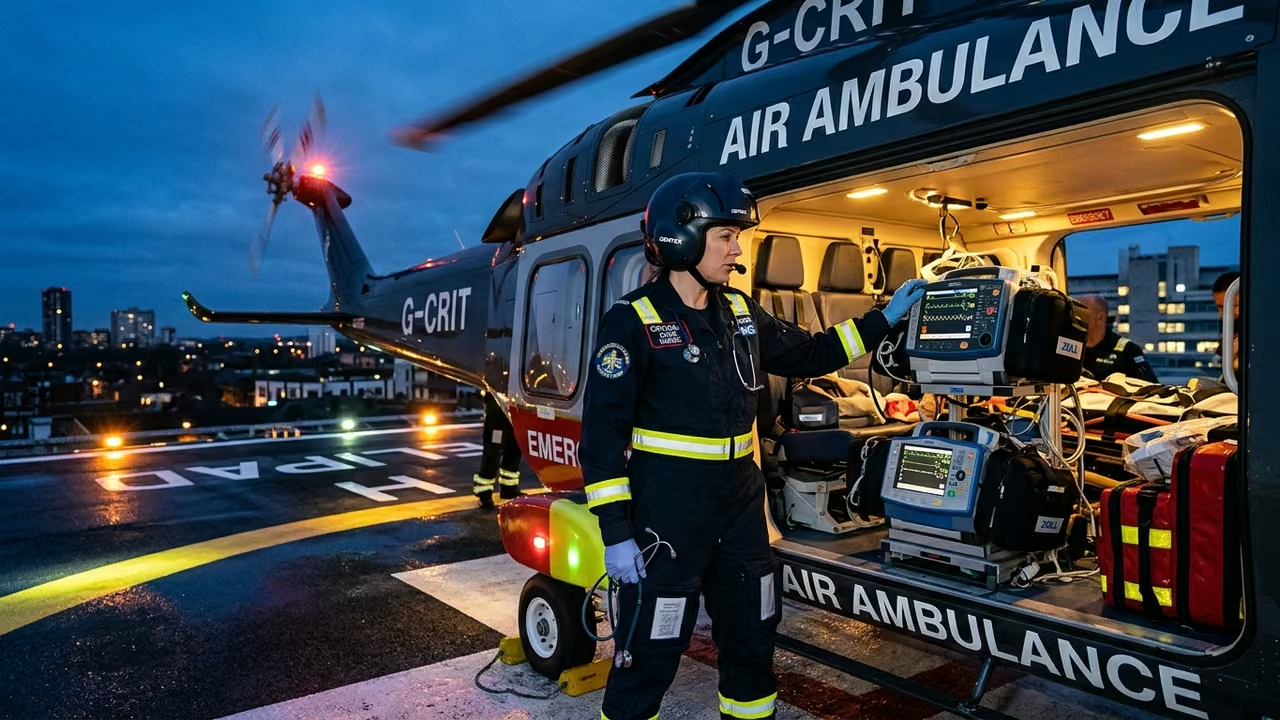
At the apex of acute critical care delivery stands the medevac nurse, also designated as an air medical transport nurse or flight registered nurse. Operating inside rotary-wing helicopters and turboprop fixed-wing aircraft, flight nurses manage unstable polytrauma victims, severe pediatric respiratory distress, cardiogenic shock, and emergency organ transport. They execute high-level invasive procedures at altitude without immediate physician supervision.
Contrasting these two roles illustrates how healthcare compensation scales from an entry-level hourly baseline of $15 to $19 per hour into an advanced clinical career exceeding $115,000 to $155,000 in annual total cash compensation.
- Foundational entry point: medical scribes handle clerical EHR documentation with zero direct patient liability, earning entry-level hourly wages.
- Critical care apex: medevac flight nurses operate advanced mobile ICUs at altitude with autonomous procedural protocols, commanding six-figure compensation.
- Compensation determinants: wage progression is driven by educational credentials, specialized board certifications, shift length, and operational hazard exposure.
- Strategic stepping stones: scribing provides irreplaceable clinical exposure that accelerates entry into high-paying nursing and physician careers.
2. Medical scribe average salary: hourly benchmarks and employment models
According to national labor statistics and medical staffing agency benchmarks, the national average hourly wage for a medical scribe ranges between $15.00 and $18.50 per hour. On an annualized basis, a full-time scribe working 40 hours per week (2,080 annual hours) earns between $31,200 and $38,480 before taxes.
However, full-time employment is relatively rare within the medical scribe workforce. The vast majority of scribes are undergraduate students, recent college graduates taking gap years, or post-baccalaureate scholars preparing for medical school, physician assistant (PA) programs, or accelerated nursing degrees. Most scribes work part-time schedules of 16 to 24 hours per week, generating actual annual earnings between $14,000 and $23,000.
Agency Employment versus Direct Hospital Hire: The structure of a scribe employment relationship creates a notable wage divide. Approximately 75% of scribes are employed by national healthcare staffing companies like ScribeAmerica, ProScribe, and Aquity Solutions. These agencies contract with hospital networks, billing health systems $28 to $35 per hour while paying the scribe $14.50 to $17.00 per hour, retaining the spread for recruiting, scheduling, and basic EHR training.
In contrast, scribes hired directly by hospital health systems or private surgical specialty practices earn $18.00 to $24.00 per hour. Direct-hire positions frequently provide comprehensive employee benefits, including employer-subsidized health insurance, 401(k) matching, and tuition assistance programs that assist pre-health students with undergraduate tuition debts.
- National scribe hourly average: $15.00 to $18.50 per hour ($31,200 to $38,480 annualized full-time equivalent).
- Part-time reality: most pre-health students log 16 to 24 hours weekly, yielding actual take-home earnings of $14,000 to $23,000.
- Agency contracting spread: third-party staffing agencies capture a 40% to 50% margin between hospital billing rates and scribe wages.
- Direct hospital employment advantage: direct-hire scribes earn $18 to $24 per hour with institutional benefits and tuition grants.
3. Medevac nurse salary: base pay, hazard premiums, and total earnings
Medevac flight nursing is widely considered one of the most elite, high-intensity roles in registered nursing. National compensation surveys indicate that full-time flight nurses earn an average base salary between $92,000 and $125,000, translating to a standard hourly base rate of $44.00 to $60.00 per hour.
However, standard base hourly wages do not capture the true earnings profile of aeromedical transport. Total annual cash compensation routinely reaches $115,000 to $145,000, with top-tier flight nurses in high-cost regions or municipal air rescue programs exceeding $165,000 annually.
Flight Hazard Pay and Environmental Stipends: Unlike hospital-based nurses who practice in climate-controlled inpatient units, flight nurses face distinct physical and aviation hazards. Air medical programs pay flight hazard differentials ranging from $3.00 to $8.00 per hour for all flight-active or on-duty hours, or provide guaranteed annual flight stipends between $8,000 and $15,000.
Shift and Specialty Differentials: Because emergency transport operations run 24 hours a day, 365 days a year, flight nurses collect substantial shift premiums. Night shifts commonly carry differentials of $4.00 to $7.00 per hour, while weekend shifts add $3.00 to $5.00 per hour. Additionally, flight programs provide retention bonuses and annual credential allowances ($2,500 to $5,000) for maintaining dual board certifications.
- Average flight nurse total compensation: $115,000 to $145,000 annually ($44.00 to $60.00 base hourly rate).
- Top 10th percentile earnings: $155,000 to $175,000+ in high-cost coastal systems or municipal fire/rescue aviation units.
- Flight hazard differential: adds $3.00 to $8.00 per hour or $8,000 to $15,000 annual stipends for aeromedical operational risks.
- Shift and weekend premiums: night differentials ($4 to $7/hr) and weekend bonuses substantially elevate annualized gross earnings.
4. Shift work economics: clinic hours versus 24-hour aeromedical rotations
A fundamental difference between medical scribes and medevac flight nurses lies in their operational scheduling paradigms and Fair Labor Standards Act (FLSA) overtime dynamics.
Medical Scribes: Predictable 8-to-10 Hour Blocks: Scribes work alongside physicians on standard 8, 9, or 10-hour daytime or evening shifts in outpatient specialty clinics, urgent care centers, or emergency departments. They clock in, document encounters in real time, finish chart notes, and clock out. Because shifts are strictly capped to minimize corporate overtime expenses, scribes rarely generate overtime earnings.
Medevac Flight Nurses: 24-Hour Shifts and Built-in Overtime: Aeromedical flight crews generally operate on 24-hour on-duty rotations followed by 72 hours off, or alternating 12-hour rotating blocks. On a 24/72 schedule, a nurse works one 24-hour shift every four days. In a typical two-week pay period, this schedule produces either 72 hours or 96 hours of on-duty time, averaging 84 hours per pay period.
Because federal labor law mandates overtime compensation for non-exempt healthcare workers exceeding 40 hours in a seven-day workweek, flight nurse contracts feature automatic built-in overtime. In every two-week pay cycle, four scheduled hours are paid at the mandatory 1.5x overtime rate. Over 26 annual pay periods, this built-in overtime adds 104 hours of time-and-a-half pay, adding $7,000 to $12,000 in baseline compensation without picking up any extra shifts.
Healthcare Shift & Overtime Earnings Formula:
Total Clinical Earnings = (Base Hourly Rate x Regular Scheduled Hours) + (Overtime Rate x 1.5 x Built-in Hours) + Shift Differentials + Flight Hazard Pay
Flight Nurse Example: ($50/hr x 1,872 Regular Hours) + ($75/hr x 208 Built-in OT Hours) + $12,000 Flight Hazard Pay + $6,000 Night Shift Differential = $127,200 Total Cash Compensation
- Scribe scheduling: predictable 8 to 10-hour shifts with tightly controlled hours and minimal overtime eligibility.
- Flight nurse 24/72 rotation: 24 hours on-duty followed by 72 hours off, averaging 84 hours per bi-weekly pay cycle.
- Built-in FLSA overtime: scheduled 24-hour shifts automatically trigger time-and-a-half pay on every standard paycheck.
- Extended rest windows: 24/72 rotations give flight nurses 21 full days off per month, providing significant lifestyle freedom.
5. Prerequisites, clinical training, and the financial ROI of nursing credentials
The vast earnings difference between medical scribes and medevac flight nurses directly mirrors the rigorous training, certifications, and high clinical barriers to entry required for aeromedical practice.
Medical Scribe Entry Requirements: Becoming a medical scribe requires a high school diploma or equivalent, basic typing proficiency (minimum 50 to 60 words per minute), and completion of a 40 to 80-hour medical terminology and EHR training curriculum provided by the hiring hospital or agency. There are no state licensure requirements or clinical malpractice obligations. Consequently, the barrier to entry is minimal, and the wage reflects an introductory training level.
Medevac Flight Nurse Entry Requirements: In stark contrast, qualifying for an aeromedical flight crew is one of the most demanding processes in clinical nursing. Transport services require a Bachelor of Science in Nursing (BSN), an unencumbered Registered Nurse license, and three to five years of continuous experience in a high-volume Level 1 or Level 2 trauma Emergency Department and surgical/cardiac Intensive Care Unit.
In addition to extensive bedside experience, flight nurses must earn and maintain rigorous board certifications: Certified Flight Registered Nurse (CFRN) or Critical Care Registered Nurse (CCRN), Certified Emergency Nurse (CEN), Advanced Cardiovascular Life Support (ACLS), Pediatric Advanced Life Support (PALS), Neonatal Resuscitation Program (NRP), and specialized trauma certifications like the Transport Nurse Advanced Trauma Course (TPATC).
The Financial ROI of the Healthcare Transition: Transitioning from an entry-level scribe ($16/hr) to an emergency bedside nurse ($42/hr) and ultimately to a medevac flight nurse ($55+/hr + overtime) represents a dramatic return on investment. Completing a four-year BSN program or an accelerated 16-month post-baccalaureate nursing degree expands annual earning power from $32,000 to over $120,000, paying back educational costs within two to three years of active clinical practice.
- Scribe prerequisites: high school diploma, typing speed, and 40 to 80 hours of basic terminology and EHR orientation.
- Flight nurse prerequisites: BSN degree, active RN license, and 3 to 5 years of Level 1 trauma ED and ICU experience.
- Mandatory advanced credentials: CFRN, CCRN, CEN, ACLS, PALS, NRP, and advanced aeromedical trauma survival training.
- Career earnings expansion: progressing from scribe to flight nurse increases annual income by $80,000 to $110,000+.
6. Detailed role comparison: medevac flight nurse vs medical scribe
The table below summarizes the key financial, operational, and clinical differences between medical scribes, hospital bedside registered nurses, and medevac critical care transport specialists.
| Role / Career Level | Average Hourly Rate | Annual Compensation Range | Typical Shift Schedule | Core Prerequisites & Risk Profile |
|---|---|---|---|---|
| Entry Medical Scribe (Agency) | $14.00 - $17.50 / hr | $29,000 - $36,000 | 8-10 hr clinic or ED shifts | High school / undergrad, EHR documentation, zero clinical risk |
| Lead / Chief Medical Scribe | $17.00 - $22.00 / hr | $35,000 - $46,000 | Full-time day / evening shifts | 1+ yr scribing, clinical workflow trainer, site scheduling |
| Staff Bedside RN (ED / ICU) | $38.00 - $52.00 / hr | $79,000 - $108,000 | Three 12-hr shifts / week | BSN, NCLEX-RN, 2-3 yrs hospital critical care baseline |
| Medevac Nurse (Rotary Wing / Helicopter) | $46.00 - $62.00 / hr | $105,000 - $145,000 | 24-hr on / 72-hr off base duty | CFRN, CCRN, 3-5 yrs trauma ICU/ED, high aviation & altitude risk |
| Medevac Nurse (Fixed-Wing / Long-Range) | $48.00 - $68.00 / hr | $115,000 - $160,000 | Multi-day flight missions / on-call | CFRN, international repatriation, flight physiology expertise |
| Per Diem / Travel Flight Nurse | $65.00 - $95.00+ / hr | $135,000 - $190,000 | Seasonal / surge transport blocks | 5+ yrs flight experience, multi-state licensure, no guaranteed hours |
7. Strategic career trajectories and wealth acceleration in healthcare
Both medical scribes and medevac flight nurses occupy strategic positions along the clinical career ladder. Maximizing lifetime earnings requires leveraging these roles into advanced clinical qualifications and prudent personal financial management.
Maximizing Value from a Scribe Position: Because scribing alone does not provide a sustainable long-term living wage in high-cost cities, scribes should treat the role purely as an intensive, paid clinical residency preparatory experience. Actively build professional relationships with attending physicians, secure strong recommendation letters, master diagnostic rationale, and transition as quickly as possible into medical school, PA school, or nursing school.
Wealth Acceleration for Flight Nurses: Because flight nurses typically work 24/72 rotations, they have 21 full days off each month. Many flight nurses monetize this downtime by working one or two supplemental per diem (PRN) shifts at hospital emergency departments or ICUs, earning $50 to $70 per hour in secondary cash flow. Picking up just two extra 12-hour hospital shifts per month generates an additional $14,400 to $20,160 in gross pre-tax income.
Advanced Career Paths Beyond Flight Nursing: Flight nursing provides a direct springboard into top-tier healthcare leadership and advanced practice nursing. Experienced flight nurses are prime candidates for Certified Registered Nurse Anesthetist (CRNA) programs ($210,000 to $260,000 average salary) or Acute Care Nurse Practitioner (ACNP) roles ($130,000 to $165,000), unlocking multi-decade financial prosperity.
- Scribe strategy: leverage physician mentorship and chart auditing experience to accelerate medical or advanced nursing school admission.
- Monetizing flight nurse downtime: pick up per diem hospital ICU/ED shifts during 72-hour off stretches to earn $15,000 to $25,000+ extra per year.
- High-earning career springboard: flight experience provides the ideal clinical background for competitive CRNA programs ($220k+ salary).
- Tax-advantaged savings: maximize employer 403(b)/401(k) matches and Roth IRAs early in your clinical career to compound clinical earnings.
Keep exploring Percentio
Browse the full directory to find related calculators and compare the assumptions that matter to your situation.
Browse all financial calculators →Related Blogs




Questions and answers
Practical answers to common planning questions.