
The Credit Card Minimum Payment Trap: How It Works & How an Extra $25 Shaves 10+ Years Off Debt
Paying only the minimum on your credit card is designed to maximize lender profits while keeping you trapped in decades of compound interest. Learn how minimum payments are calculated and how to break free.

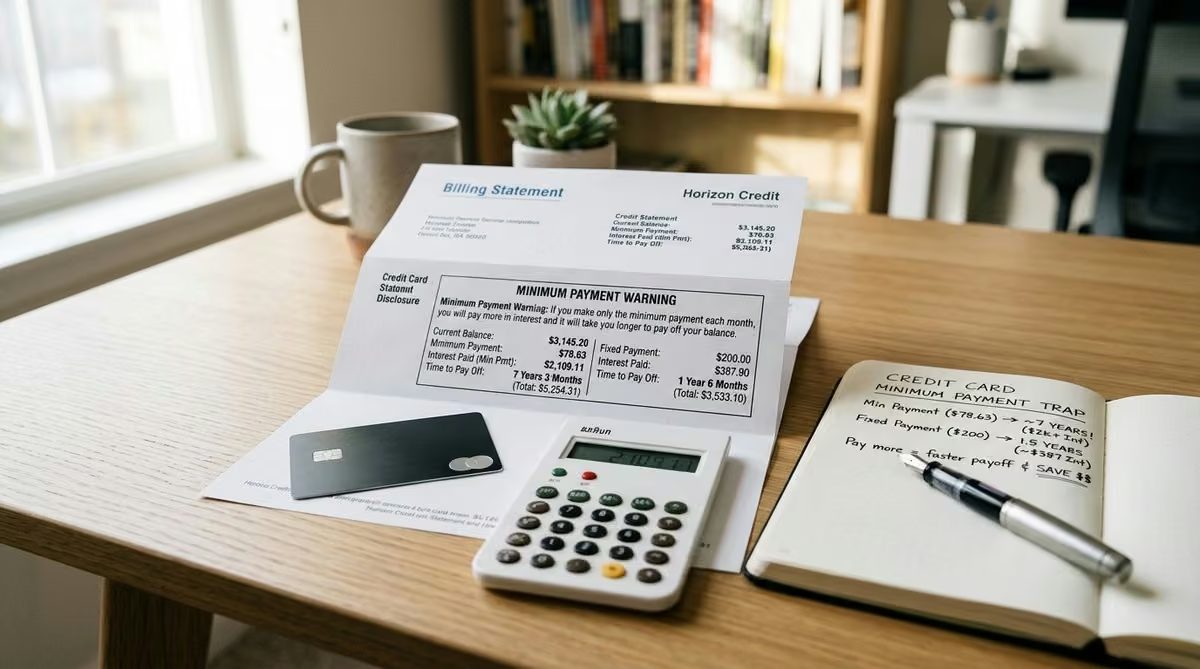
Try our free Credit Card Payoff Calculator to calculate your payoff timeline and interest savings.
1. The Anatomy of a Minimum Payment: The Card Issuer Formula Unveiled
Most cardholders assume that credit card minimum payments represent a steady, structured repayment schedule similar to an auto loan or a fixed-rate mortgage. In truth, credit cards are open-ended revolving lines of credit, and their minimum payment formulas are mathematically engineered to accomplish two competing objectives: keep the monthly bill low enough that the borrower does not default, while keeping the balance lingering long enough to extract maximum compound interest over decades.
Under the Credit Card Accountability Responsibility and Disclosure (CARD) Act of 2009, major card issuers (such as JPMorgan Chase, Citibank, Capital One, Discover, and Bank of America) are legally required to ensure that monthly minimum payments cover accrued interest plus a tiny fraction of principal. Prior to 2009, some lenders set minimum payments so low that they did not even cover monthly interest, causing balances to expand—a predatory dynamic known as negative amortization.
Today, virtually all major U.S. credit card issuers calculate minimum payments using one of two standard formula models:
Standard Issuer Minimum Payment Formula:
Minimum Payment = max($35, (0.01 * Balance) + Monthly Accrued Interest + Late Fees)
Monthly Accrued Interest Calculation:
Monthly Interest = Current Balance * (APR / 12)
Example on $4,000 Balance at 24.99% APR:
Monthly Interest = $4,000 * (0.2499 / 12) = $83.30
Principal Reduction (1%) = $4,000 * 0.01 = $40.00
Required Minimum Due = $83.30 + $40.00 = $123.30
- The Standard Percentage-Plus-Interest Formula (Most Common): Minimum Payment = Greater of $35 (the floor) OR (1.0% of Current Principal Balance + Monthly Accrued Interest + Any Past Due Fees).
- The Flat Percentage Formula: Minimum Payment = Greater of $35 OR (2.0% to 2.5% of Total Statement Balance).
- The Minimum Floor Rule: If your total balance is less than the floor (typically $25 to $35), the required minimum payment is equal to your remaining balance in full.
Notice the staggering mathematical consequence of the standard 1% formula: when you make a $123 minimum payment on a $4,000 balance, exactly $83.30 goes straight into the bank’s pocket as interest profit, while a meager $40.00 is credited toward reducing your debt. More than two-thirds of your hard-earned cash disappears before cutting a single penny of principal!
2. The $4,000 Worked Case Study: Minimum Payments vs. Fixed Accelerated Payments
To understand why financial advisors refer to minimum payments as a "wealth-destroying trap," you must examine how the math compounds over time. Let us analyze a realistic scenario: a consumer carrying a single credit card balance of $4,000 at a standard variable rate of 24.99% APR.
We compare five distinct repayment strategies using the exact same starting balance and interest rate. Crucially, we assume that zero additional purchases, balance transfers, or cash advances are made on the card during the entire repayment period.
| Repayment Strategy | Monthly Payment Amount | Total Payoff Time | Total Interest Paid | Total Cash Paid | Net Savings vs. Minimum |
|---|---|---|---|---|---|
| Statement Minimum Only | Declining ($123 -> $35 floor) | 180 months (15.0 years) | $6,742 | $10,742 | Baseline (The Trap) |
| Fixed Initial Minimum | Fixed $125 / month | 54 months (4.5 years) | $2,658 | $6,658 | Saves $4,084 & 10.5 Years |
| Fixed $150 / month (+$25) | Fixed $150 / month | 40 months (3.3 years) | $1,898 | $5,898 | Saves $4,844 & 11.7 Years |
| Fixed $175 / month (+$50) | Fixed $175 / month | 32 months (2.7 years) | $1,488 | $5,488 | Saves $5,254 & 12.3 Years |
| Fixed $225 / month (+$100) | Fixed $225 / month | 23 months (1.9 years) | $1,048 | $5,048 | Saves $5,694 & 13.1 Years |
The findings from this numerical model are jaw-dropping:
1. Paying Only the Minimum takes 15 full years (180 months) and costs $6,742 in interest. You end up paying nearly triple ($10,742) what you originally borrowed!
2. Simply Freezing the Initial Minimum at $125/month—without adding a single extra dollar—reduces your payoff time from 15.0 years down to 4.5 years and saves $4,084 in cold hard cash.
3. Adding Just $25 Extra ($150/month) slashes another 14 months off the schedule, freeing you in 3.3 years and saving nearly $5,000 in interest.
4. Adding $100 Extra ($225/month) completely eliminates the entire $4,000 balance in under two years (23 months), cutting total interest down to just $1,048.
3. The "Ratchet Effect": Why Minimum Payments Keep You Trapped for Decades
Why does paying the minimum take 15 years, while paying a fixed $125 takes only 4.5 years? The secret lies in a banking mechanism known as the "minimum payment ratchet."
Because credit card minimum payments are calculated as a percentage of your current statement balance, the dollar amount of your required payment automatically shrinks every single month that your balance declines. Look at how the ratchet unfolds across the first three years of repayment on a $4,000 balance:
- Month 1: Balance = $4,000.00. Minimum payment = $123.30 ($40.00 principal, $83.30 interest).
- Month 12: Balance = $3,546.12. Minimum payment = $109.31 ($35.46 principal, $73.85 interest).
- Month 24: Balance = $3,122.45. Minimum payment = $96.24 ($31.22 principal, $65.02 interest).
- Month 36: Balance = $2,735.80. Minimum payment = $84.32 ($27.36 principal, $56.96 interest).
- Month 60+: Balance hits ~$1,500. Payment hits the $35.00 floor. At this stage, progress grinds to an absolute crawl for the next decade.
When cardholders see their monthly bill drop from $123 down to $96, they naturally feel a sense of relief and pay only the lower amount. But by reducing your monthly payment, you are actively slowing down your own progress! You are allowing the bank to stretch out your principal repayment over 180 billing cycles so that they can continue collecting lucrative monthly finance charges.
To break the ratchet effect, you must never allow your payments to decline. When your balance decreases, keep sending the same fixed initial payment (or more). Every dollar of difference between the new statement minimum and your fixed payment goes 100% directly to principal reduction.
4. The Power of Asymmetric Acceleration: How an Extra $25 Destroys Daily Compounding
Most consumers underestimate the profound impact of modest extra payments. Adding $25 a month—less than one dollar a day—might seem like a drop in the ocean against a $4,000 debt. But in credit card mathematics, extra principal payments produce an asymmetric compounding effect.
Credit cards do not calculate interest annually or monthly. They calculate interest daily using the Daily Periodic Rate (DPR):
Daily Periodic Rate (DPR) Formula:
DPR = Annual Percentage Rate (APR) / 365 days
Example at 24.99% APR: DPR = 0.2499 / 365 = 0.00068466 (0.0685% per day)
Daily Interest on $4,000 Balance = $4,000 * 0.00068466 = $2.74 per day ($82.16 / month)
Daily Interest on $2,500 Balance = $2,500 * 0.00068466 = $1.71 per day ($51.35 / month)
Because minimum payments are already covering all accrued interest, 100% of any extra cash you send goes directly toward knocking down the principal balance. And when principal drops, tomorrow’s daily interest charge immediately drops with it.
This creates a virtuous reverse-compounding cycle: lower principal generates less interest tomorrow; lower interest leaves more of your next payment to reduce principal; and within 12 to 24 months, the debt collapses in on itself.
5. Multiple Credit Cards: Using Minimum Payments Strategically in Avalanche & Snowball
If minimum payments are a trap, does that mean you should stop paying them? Absolutely not! When managing multiple credit cards, minimum payments are your defensive armor.
Failing to pay the minimum on even one card triggers catastrophic financial consequences:
- Immediate Late Fees: Federal regulations permit card issuers to charge late fees of up to $30 for a first offense and up to $41 for a second missed payment within six billing cycles.
- Severe Credit Score Damage: Missing a payment by 30 days is reported to the three major credit bureaus (Equifax, Experian, TransUnion), causing credit scores to plummet by 50 to 100+ points instantly.
- Penalty APR Triggers: Most card agreements stipulate that if you are 60 days late, the issuer can hike your interest rate to a punitive Penalty APR—frequently 29.99% to 34.99%—applied to your entire outstanding balance.
- Loss of Promotional Financing: Missing a single payment immediately terminates any active 0% introductory APR promotional periods.
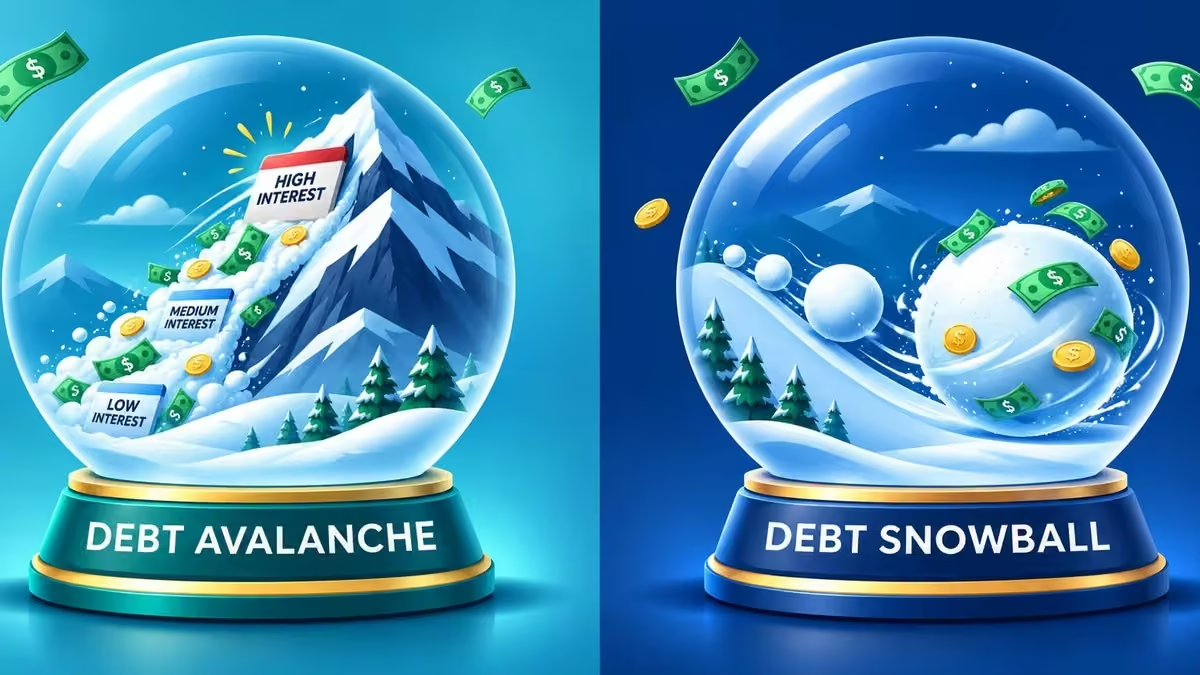
The correct strategic role of minimum payments is to automate them across all non-priority accounts. Under both the Debt Avalanche method (targeting highest APR first) and Debt Snowball method (targeting smallest balance first), you put every non-target card on automatic minimum payment to protect your credit and avoid penalties, while funneling 100% of your extra budget into your single target account.
To compare how minimum payments roll over into the Avalanche vs Snowball methods with worked portfolio math, read our guide on Debt Snowball vs. Debt Avalanche: Which Strategy Actually Saves More Money?.
For step-by-step guidance on organizing statements and due dates across multiple cards, see our companion guide on How to Pay Off Multiple Credit Cards Step by Step.
6. Card Issuer Billing Quirks & Traps to Watch Out For
Executing an aggressive credit card payoff requires understanding how banks process payments, calculate average balances, and apply funds under federal regulations.
Here are four critical billing rules and issuer traps you must navigate:
- The Average Daily Balance (ADB) Method: Issuers sum your ending balance on each day of the billing cycle and divide by the number of days in the cycle. This means making a payment on Day 5 of your billing cycle saves significantly more interest than waiting until the payment due date on Day 25, because your average balance for the entire month is lower!
- CARD Act Payment Allocation Rules: If your card has different balances carrying different interest rates (for example, a $2,000 balance at 0% promotional APR and a $1,000 balance at 24.99% purchase APR), federal law requires the issuer to apply your minimum payment to the lowest APR balance, but any amount paid ABOVE the minimum must be applied to the highest APR balance first.
- The 0% Deferred Interest Penalty: Store retail cards frequently offer "0% interest for 12 months." Unlike true 0% APR promotions, deferred interest states that if even a $1 balance remains unpaid on day 366, you will be retroactively billed for 12 months of back-interest on the entire original purchase amount. Never pay only the minimum on deferred-interest financing!
- Trailing (Residual) Interest: When you make your final payoff payment, daily interest accrued between your last statement closing date and the day your payment posted will appear on the subsequent monthly statement. Always verify your account 30 days after paying off a card to clear any residual pennies.
7. The 5-Step Action Plan to Break the Minimum Payment Cycle Forever
Breaking free from credit card debt does not require an impossible budget overhaul. It requires shifting from reactive, bank-dictated minimum payments to proactive, fixed repayment rules.
Follow this proven 5-step blueprint to permanently crush your credit card balances:
- Step 1: Inventory Your Accounts and Baseline Minimums. Log into each card portal and record current balances, APRs, and current statement minimum payments. Use Percentio’s Debt Payoff Calculator to find your exact baseline total.
- Step 2: Lock in Fixed Autopay Amounts. Navigate to your bank or cardholder portal’s automatic payment settings. Never choose "Pay Minimum Amount Due." Instead, select "Pay Fixed Amount" and set it to your initial minimum payment plus whatever extra cushion ($25, $50, or $100) you can commit to.
- Step 3: Freeze Card Spending During the Payoff Sprint. Remove credit card numbers from autofill on your web browser and shopping apps. Use debit or cash for daily living expenses so new transactions do not offset your repayment progress.
- Step 4: Align Payment Timing With Your Paycheck. Move your payment due dates (or schedule mid-cycle payments) immediately after your payday to reduce your Average Daily Balance and eliminate interest before it accrues.
- Step 5: Execute the Payment Rollover Engine. When your first card reaches zero balance, do not lower your monthly debt budget! Take that card’s entire former fixed payment and add it to your next target card until every account reads $0.00.
Keep exploring Percentio
Browse the full directory to find related calculators and compare the assumptions that matter to your situation.
Browse all financial calculators →Related Blogs
Debt Snowball vs. Debt Avalanche: Which Strategy Actually Saves More Money? (With Worked Calculations)

How to Pay Off Multiple Credit Cards: Avalanche vs. Snowball Worked Example

How an Amortization Schedule Works: The Exact Math, Formulas & Extra Payments Strategy

How Much Equity Do I Have in My Home? Formula, Usable Equity & Calculator Guide
Frequently Asked Questions About Credit Card Minimum Payments
Practical answers to common planning questions.