
Debt Snowball vs. Debt Avalanche: Which Strategy Actually Saves More Money? (With Worked Calculations)
Compare the debt snowball and debt avalanche payoff methods to determine whether psychological quick wins or mathematically optimized interest savings will eliminate your balances faster.

Try our free Debt Payoff Calculator to calculate your debt-free date and total interest.
1. The Fundamental Difference: Behavioral Psychology vs. Pure Mathematics
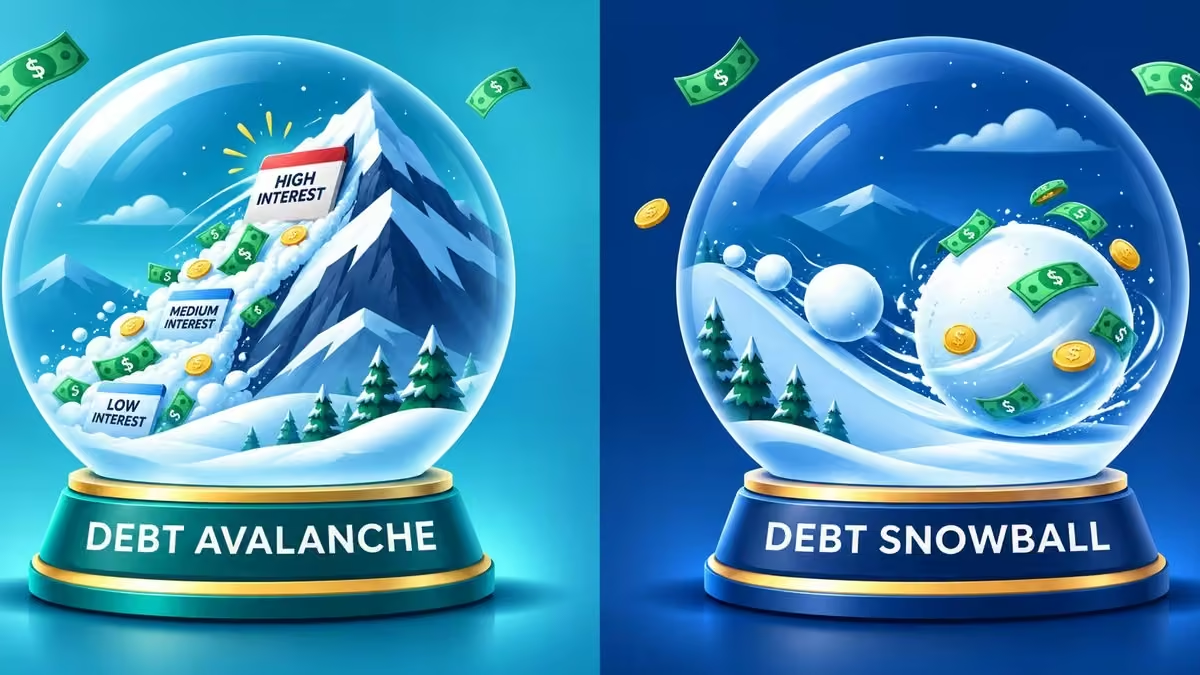
If you ask a spreadsheet or a computer algorithm how to pay off debt, it will invariably give you one answer: pay off the account with the highest interest rate first. Every dollar allocated to an account with a 24.99% Annual Percentage Rate (APR) stops more compounding interest than a dollar allocated to a 7.50% loan. This is the Debt Avalanche method—the mathematically optimal repayment path designed to minimize total lifetime interest charges.
Yet if you ask behavioral economists, certified financial planners, and researchers who study human decision-making, they will often advise the exact opposite: pay off your smallest balance first, regardless of the interest rate. This is the Debt Snowball method—a strategy popularized by financial author Dave Ramsey that prioritizes human motivation, quick psychological victories, and behavioral momentum over pure mathematical efficiency.
Crucially, both strategies share the exact same underlying mechanics. Under both methods, you never ignore any of your debts. You make the required minimum monthly payment on every single loan and credit card account to preserve your credit rating, avoid late fees, and prevent penalty APR triggers. You then take whatever extra cash you can scrape together—whether $100, $300, or $500 a month—and funnel 100% of it into one single target account. Once that target account drops to an absolute balance of zero, you roll its entire payment (both the minimum payment and the extra cash) into the next target debt on your list, creating an accelerating financial wave.
- Debt Snowball: Rank all non-mortgage debts by balance size from smallest to largest. Ignore interest rates completely. Focus all extra cash on Debt #1 until eliminated, then roll the total payment into Debt #2.
- Debt Avalanche: Rank all non-mortgage debts by Annual Percentage Rate (APR) from highest to lowest. Ignore balance size completely. Focus all extra cash on the highest-rate debt until eliminated, then roll the payment into the next highest-rate account.
- The Shared Rollover Engine: Neither strategy reduces your total monthly debt budget when an account is cleared. Instead, every eliminated bill increases the firepower applied to the next debt, shrinking repayment time exponentially.
The core debate between Snowball and Avalanche is not whether one works and the other fails—both have helped millions of households achieve debt freedom. The real question is: Are you more likely to complete a 3-year debt repayment plan by saving an extra few hundred dollars in interest, or by experiencing tangible psychological victories in your first 90 to 180 days?
2. The $24,000 Worked Case Study: Side-by-Side Numerical Showdown
To understand the real-world trade-off between the Snowball and Avalanche methods, theoretical arguments are not enough—you need to look at exact dollar-for-dollar amortization math. Let us analyze a realistic household debt profile representing $24,000 in total outstanding debt across four distinct accounts with varying balances, interest rates, and minimum payment requirements.
In this scenario, our borrower has a total baseline monthly minimum obligation of $550 across all four debts. By tightening their household budget, canceling unused recurring subscriptions, and budgeting carefully, they establish a total monthly debt elimination budget of $850. This creates $300 per month in "extra acceleration capital" that can be targeted toward debt elimination.
Monthly Debt Acceleration Budget = Baseline Minimums ($550) + Extra Principal ($300) = $850 / month
Snowball Phase 1 Target: Debt A ($1,500 @ 0%) receiving $50 min + $300 extra = $350 / month
Avalanche Phase 1 Target: Debt B ($4,500 @ 24.99%) receiving $120 min + $300 extra = $420 / month
| Account Name | Current Balance | APR (%) | Min. Monthly Payment | Snowball Priority | Avalanche Priority |
|---|---|---|---|---|---|
| Debt A: Medical Bill | $1,500 | 0.00% | $50 | #1 (Smallest Balance) | #4 (Lowest APR) |
| Debt B: Retail Credit Card | $4,500 | 24.99% | $120 | #2 (Second Smallest) | #1 (Highest APR) |
| Debt C: Major Bank Card | $8,000 | 19.99% | $200 | #3 (Third Smallest) | #2 (Second Highest) |
| Debt D: Private Student Loan | $10,000 | 7.50% | $180 | #4 (Largest Balance) | #3 (Third Highest) |
| Total Portfolio | $24,000 | 14.86% (Weighted) | $550 / month | Snowball Order: A -> B -> C -> D | Avalanche Order: B -> C -> D -> A |
Simulations reflect fixed $850 monthly repayment allocation, exact daily interest accrual, and seamless payment rollover upon balance zeroing. Calculations assume zero additional charges or card usage during the repayment period.
- Debt Snowball Execution: The borrower directs $350/mo to Debt A (Medical Bill). Debt A is paid off in Month 5! The freed $350 rolls into Debt B, raising Debt B payments to $470/mo ($120 + $350). Debt B is fully eliminated in Month 15. The freed $470 rolls into Debt C, raising payments to $670/mo ($200 + $470). Debt C is eliminated in Month 27. Finally, the full $850 budget attacks Debt D, clearing it completely in Month 35.
- Debt Avalanche Execution: The borrower directs $420/mo to Debt B (24.99% Card). Debt B is paid off in Month 13. The freed $420 rolls into Debt C, raising Debt C payments to $620/mo ($200 + $420). Debt C is eliminated in Month 26. The freed $620 rolls into Debt D (7.50% Student Loan), raising payments to $800/mo ($180 + $620). Debt D is eliminated in Month 34. Finally, Debt A (0% Medical) is paid off in Month 34.
Now let us model the exact month-by-month repayment journey of both strategies using the same $850 monthly budget. We calculate daily compounding interest, account minimum reductions, and full payment rollovers upon each account closure.
3. Comparing the Payoff Results: The $503 Difference
When we compare the final outcomes side by side, the mathematical reality becomes crystal clear. The Debt Avalanche method saved $503 in cash interest ($4,583 total interest paid versus $5,086 for the Snowball) and freed the borrower from debt 1 month earlier (34 months versus 35 months).
However, the timing of emotional relief was drastically different. Look closely at when each account reached zero balance:

| Repayment Metric | Debt Snowball Method | Debt Avalanche Method | Winner / Practical Advantage |
|---|---|---|---|
| First Account Fully Paid Off | Month 5 (Debt A - Medical) | Month 13 (Debt B - Credit Card 1) | Snowball: Win in 5 months vs 13 months |
| Second Account Paid Off | Month 15 (Debt B - Credit Card 1) | Month 26 (Debt C - Credit Card 2) | Snowball: 2 accounts closed in 15 months |
| Third Account Paid Off | Month 27 (Debt C - Credit Card 2) | Month 30 (Debt A - Medical) | Avalanche: High-interest debt gone sooner |
| Final Debt-Free Date | Month 35 (2 years, 11 months) | Month 34 (2 years, 10 months) | Avalanche: Finished 1 month earlier |
| Total Lifetime Interest Paid | $5,086 | $4,583 | Avalanche: Saves $503 in cold cash |
| Number of Monthly Bills After 6 Months | 3 bills remaining | 4 bills remaining | Snowball: Reduced administrative clutter immediately |
Under the Debt Snowball, the borrower experienced their first life-changing victory in Month 5. Eliminating the medical bill eliminated a physical creditor statement, removed a monthly obligation from their desk, and proved beyond a shadow of a doubt that their debt plan was working. By Month 15, half of their four debts were completely eliminated.
Under the Debt Avalanche, the borrower spent over a year—13 consecutive months of scrimping, sacrificing, and sending $420 every single month to a high-rate card—before a single account reached zero. For 13 months, they still had to manage four bills, log into four servicer portals, and track four due dates. If that borrower experienced unexpected car repairs, medical emergencies, or motivation fatigue during month 8 or 9, they were at severe risk of giving up entirely.
4. The Science of Momentum: Why Behavioral Economists Endorse the Snowball
For years, mathematical purists dismissed the Debt Snowball as "financial foolishness," arguing that paying extra on a 0% medical bill while letting a 24.99% credit card balance linger was irrational. However, groundbreaking academic research over the past decade has proven that human psychology, not mathematical spreadsheets, determines whether borrowers actually succeed in eliminating debt.
In a seminal study published in the Journal of Marketing Research by researchers from the Kellogg School of Management at Northwestern University (Amar, Ariely, Ayal, Cryder, and Loewenstein), researchers analyzed empirical data from thousands of real-world debt settlement programs. Their conclusion was striking: the single greatest predictor of debt repayment success was not the amount of interest saved, but the proportion of accounts closed.
Borrowers who concentrated extra funds on eliminating small accounts first were significantly more likely to eliminate all of their debts compared to those who distributed funds according to interest rates. The researchers termed this the "debt account closing effect."
- The Dopamine Reward Loop: Human motivation is governed by dopamine hits triggered by reaching tangible milestones. Seeing a debt balance drop from $5,000 to $3,800 provides minimal emotional reinforcement. In contrast, seeing a balance drop from $200 to $0.00 and receiving a "Paid in Full" letter triggers an immense surge of satisfaction, reinforcing future discipline.
- Reduced Cognitive Overload: Tracking multiple credit card portals, due dates, minimum payments, and billing cycles creates chronic mental fatigue. Closing an account permanently eliminates one monthly administrative chore, freeing up mental bandwidth.
- Risk of Abandonment: The greatest financial danger in debt payoff is not paying an extra $500 in interest over three years; it is abandoning the payoff plan in month 8 because of burnout and spending another decade trapped in revolving minimum payments.
- Harvard Business Review Insights: Further behavioral research highlighted that consumers perceive progress not by total dollars paid, but by the percentage of discrete goals accomplished. Closing 2 out of 4 accounts feels like 50% completion, even if the total dollar reduction is only 25%.
As behavioral economist Dan Ariely noted, personal finance is far more "personal" than it is "finance." If a strategy saves you $500 on paper but has a 40% higher dropout rate, the mathematical savings are an illusion. The best strategy is always the one you will actually finish.
5. The "Hybrid" Payoff Strategy: Bridging Psychology and Mathematics
What if you do not have to choose between cold mathematical efficiency and warm psychological motivation? Savvy financial planners often recommend a "Hybrid Payoff Strategy"—an approach that captures 85% to 90% of the avalanche interest savings while still providing the rapid motivational fuel of the snowball.
The Hybrid strategy divides your debt repayment journey into two distinct, deliberate phases: the Momentum Phase and the Mathematical Phase.
- Phase 1: The Quick-Win Blitz (Snowball Rules). Look at all your debts and identify any "nuisance balances" under $1,500 to $2,000 (such as small store cards, outstanding medical copays, or old utility collections). Direct all extra payment acceleration to eliminate these micro-debts first, regardless of APR. Your objective is strictly psychological and administrative: wipe out 1 or 2 accounts in the first 3 to 6 months to simplify your life and prove your system works.
- Phase 2: The Avalanche Pivot (Mathematical Rules). Once all balances below $2,000 are eliminated, your remaining debts will typically consist of larger, substantive obligations (e.g., $5,000 to $15,000 credit cards, personal consolidation loans, or student debt). Immediately switch to strict Avalanche priority: target the debt with the highest APR first to kill dangerous compounding interest.
- Phase 3: The Low-Interest Finish. Debts with interest rates below 6% or 7% (such as subsidized student loans or low-rate auto loans) remain on automated minimum payments until all double-digit consumer debt is completely eradicated.
When applied to our $24,000 case study, the Hybrid strategy delivers an astounding result: the borrower eliminates Debt A (Medical) in Month 5 for an early psychological win, then immediately pivots to Debt B (24.99% card), clearing it by Month 15, Debt C by Month 26, and Debt D by Month 34. Total interest paid is $4,710—saving $376 of the mathematical advantage while securing the critical Month 5 account closure!
6. Step-by-Step DIY Spreadsheet Setup (Excel & Google Sheets)
While online calculators provide instant clarity, many borrowers prefer building a personalized debt tracker in Microsoft Excel or Google Sheets. Having a live spreadsheet on your computer gives you complete ownership over your numbers and lets you update your balances after every paycheck.
To build a clean, automated debt snowball or avalanche tracker from scratch, set up a table with the following seven essential columns:
Snowball Dynamic Sort Formula (Order by Balance Ascending):
=SORT(A2:D5, 2, TRUE)
Avalanche Dynamic Sort Formula (Order by APR Descending):
=SORT(A2:D5, 3, FALSE)
Monthly Accrued Interest Formula for Cell E2:
=ROUND(B2 * (C2 / 12), 2)
- Column A: Creditor / Account Name (e.g., "Chase Freedom", "CareCredit Medical")
- Column B: Current Balance ($)
- Column C: Annual Percentage Rate (APR as a percentage, e.g., 24.99%)
- Column D: Required Minimum Monthly Payment ($)
- Column E: Monthly Accrued Interest Formula: =B2*(C2/100)/12
- Column F: Target Monthly Payment (Minimum Payment + Extra Allocated Principal)
- Column G: Calculated Payoff Date or Remaining Months
Once an account balance hits $0.00, make sure to add an IF formula to your target payment column so that the cleared payment automatically rolls into the next active row, simulating the compounding acceleration effect without manual re-calculation.
For detailed instructions on managing multiple card balances and avoiding minimum payment pitfalls, read our in-depth companion guide on How to Pay Off Multiple Credit Cards Step by Step.
If your debt portfolio includes fixed-rate personal loans, car notes, or mortgages, understand how interest amortizes over time with our guide on How an Amortization Schedule Works: The Exact Math & Formulas.
7. Issuer Gotchas, Traps & Servicer Rules to Watch Out For
Regardless of whether you choose the Debt Snowball, Debt Avalanche, or a Hybrid approach, executing a debt payoff plan in the real world requires navigating credit card issuer policies, variable interest adjustments, and lender billing quirks.
Here are the five most common traps that derail debt repayment plans—and how to avoid them:
- The Minimum Payment Ratchet Trap: Credit card issuers typically calculate your minimum payment as a percentage of your current balance (usually 1% to 2% of principal plus monthly accrued interest). As your balance decreases, the card issuer automatically lowers your required minimum payment. If you only pay the new lower minimum, your payoff timeline stretches out for decades! Solution: Never pay the minimum. Keep paying your original baseline minimum even as the statement minimum drops.
- Trailing (Residual) Interest: When you pay off a revolving credit card balance in full, you may be surprised to see a small bill (e.g., $18.42) arrive on the subsequent month statement. This is trailing interest—the interest accrued between the date your statement was generated and the date your final payment posted. Solution: Always check the statement following your zero-balance payoff and pay any lingering pennies immediately to prevent a late fee.
- Variable APR Rate Hikes: Most credit cards carry variable interest rates tied to the U.S. Prime Rate (Wall Street Journal Prime). When the Federal Reserve adjusts benchmark interest rates, credit card APRs rise automatically without prior notice. An account that was 19.99% last year might now be 24.99%, expanding the interest advantage of the Avalanche method.
- 0% Promotional Deferred Interest vs. True 0% APR: Store credit cards frequently advertise "No Interest if Paid in Full Within 12 Months." This is often deferred interest. If you fail to pay off 100% of the balance by day 365—even if you leave a single $5 balance—the issuer retroactively charges you interest on the entire original purchase amount dating back to day one! Solution: Under both Snowball and Avalanche, treat deferred interest promotions as urgent Priority #1 debts that must be cleared at least 30 days before promo expiration.
- Installment Loan Prepayment Designation: When sending extra money to an auto loan, student loan, or mortgage, some loan servicers mistakenly categorize extra cash as "Paid Ahead" (advancing your next monthly due date) rather than reducing principal balance. Solution: Explicitly instruct your servicer online or on payment checks to "Apply Extra Funds Directly to Principal Balance."
8. Decision Matrix: Which Strategy Fits Your Financial Personality?
Choosing between the Debt Snowball and Debt Avalanche ultimately comes down to an honest self-assessment of your financial temperament, cash flow flexibility, and past behavioral history. There is no moral superiority in mathematics if you fail to finish the race.
Use the following diagnostic matrix to determine which payoff path is engineered for your specific personality:
| Financial Scenario / Personality Trait | Recommended Strategy | Primary Justification |
|---|---|---|
| You feel overwhelmed by clutter and have 5+ small credit card accounts | Debt Snowball | Rapidly reduces account count from 5 to 2, restoring control and clarity. |
| You have large credit cards with extreme APR differences (e.g. 29% vs 6%) | Debt Avalanche | Targeting the 29% card saves thousands in toxic compounding interest. |
| You have started and stopped debt payoff plans multiple times in the past | Debt Snowball | Delivers quick psychological wins within 90 days to establish lasting habits. |
| You are an analytical, disciplined spreadsheet user with stable income | Debt Avalanche | Mathematically pure; maximizes lifetime net worth and cash efficiency. |
| You have 1 or 2 small debts under $1,500 and 2 large high-interest cards | Hybrid Strategy | Clears small nuisance debts in months 1-4, then attacks high-APR balances. |
| You are facing imminent promo expiration on a 0% deferred-interest card | Targeted Emergency | Clear deferred interest card first regardless of strategy to avoid retroactive penalty. |
Remember: The best debt payoff strategy is never the one that looks prettiest on a whiteboard. The best debt payoff strategy is the one that you stick with until every single balance statement reads $0.00.
Keep exploring Percentio
Browse the full directory to find related calculators and compare the assumptions that matter to your situation.
Browse all financial calculators →Related Blogs

How to Pay Off Multiple Credit Cards: Avalanche vs. Snowball Worked Example

How an Amortization Schedule Works: The Exact Math, Formulas & Extra Payments Strategy

How Much Equity Do I Have in My Home? Formula, Usable Equity & Calculator Guide

The Credit Card Minimum Payment Trap: How It Works & How an Extra $25 Shaves 10+ Years Off Debt
Frequently Asked Questions About Debt Snowball vs. Debt Avalanche
Practical answers to common planning questions.